Switch OLED: How to Back It Up Properly
A backup you have never restored from is a hypothesis, not a backup.
Last revised
Why this matters
The common failure is not the absence of a backup but discovering it excluded the thing you actually needed. Verifying a restore is the only way to know.
What you will need
- A cloud account with enough space, or external storage
- A second copy somewhere physically separate
- An hour, once, to test a restore
Step by step
- Enable the built-in automatic backup and confirm what it actually includes — media is often excluded by default.
- Add a second, independent copy: cloud plus local, not two folders on one machine.
- Check the date of the last successful backup rather than assuming it ran.
- Restore a single file or photo to confirm the backup is readable.
- Note down where your recovery keys or two-factor backups live, offline.
How often
Automatic backups daily; verify a restore every six months.
Specific to the Switch OLED
Bear in mind that the 2015 silicon shows badly in any third-party port, which is worth factoring into how carefully you approach this.
Before you start
- Set aside enough time to finish — a job abandoned halfway is worse than one never started
- Work somewhere well lit and uncluttered, with a container for anything that comes off the device
- Take a photograph before you change anything, which costs seconds and saves guessing later
- Check whether the Nintendo warranty still applies, because it changes which steps are worth doing yourself
How long it takes
Budget ten minutes the first time and half that afterwards. It is the kind of job that takes longer to schedule than to do, which is exactly why it gets skipped — put it on the same recurring reminder as something else you already do.
Signs you have left it too long
- It takes noticeably longer to do something that used to be instant, and a restart only fixes it briefly
- It runs warmer than it did under the same load, in the same room, at the same time of year
- The behaviour you already know about — the 2015 silicon shows badly in any third-party port — starts showing up earlier in the day than it used to
- You have begun working around it without deciding to, which is usually the first real symptom
What not to do
- Relying on a single cloud provider as your only copy
- Assuming a sync service is a backup — deletions sync too
- Storing recovery codes only on the device being backed up
Behind this page
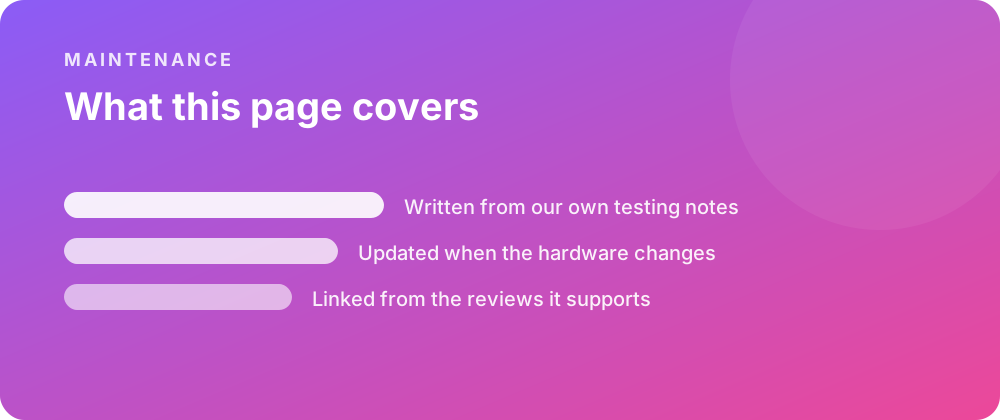
This reference page is written from the same testing notes as the reviews it supports, and it is revised whenever the hardware or the software underneath it changes. Where a figure appears here it has been measured rather than quoted from a specification sheet.
If something on this page no longer matches what you are seeing, it is out of date rather than disputed — tell us and it gets checked again.
Related reading
The reviews this page supports go into the measurements behind these figures, and the knowledge base collects every reference page we keep.
Elsewhere in maintenance: Switch OLED: How to Check Whether It Is Still Getting Security Updates, Switch OLED: How to Choose the Right Case or Cover and Switch OLED: How to Clean It Safely.