Legion Go Review: Good Idea, Uneven Execution
Our full Legion Go review after two weeks of testing: measured performance, battery figures, and whether it is worth £699.
 Tech Daily Review Desk

Where it lands
The Legion Go is Lenovo's 2023 entry in a crowded gaming Hardware market, and at £699 it is competing against some of the strongest hardware we have tested. After a fortnight of daily use, the headline is straightforward: it delivers the largest and highest resolution handheld screen at 8.8in 1600p.
Verdict in one line: Buy it for the largest and highest resolution handheld screen at 8.8in 1600p. Think twice if this would bother you daily: 854g is genuinely too heavy to hold comfortably.
Build and materials
There is nothing experimental here, which is mostly to the Legion Go's credit. The detail worth calling out is that it was the heaviest device in this group by 176g. Against the rest of the gaming Hardware category it feels considered rather than novel.
What it can do
Our testing runs the same suite on every device so figures stay comparable across years. The figure worth quoting is Play time: 1h 50m in demanding titles. That places it mid-table at best for its price bracket.
| Specification | Legion Go |
|---|---|
| Display | 8.8in IPS, 144Hz, 500 nits |
| Chip | AMD Ryzen Z1 Extreme |
| RAM | 16GB LPDDR5X |
| Storage | 512GB NVMe |
| Weight | 854g |
| Battery | 49.2Wh |
| Play time | 1h 50m in demanding titles |
How we tested
Every figure quoted above comes from the same protocol, run on every unit in this category. This one spent two weeks as the reviewer’s only games machine, across a fixed set of twelve titles. The same twelve games on every device, handhelds at a metered 200 nits, consoles on a calibrated 4K 120Hz OLED.
| What we measure | How |
|---|---|
| Play time | Battery life in three demanding titles at default settings, averaged, from full to shutdown. |
| Sustained frame rate | Thirty minutes of continuous play, reporting the 1% low rather than the average. |
| Load time | Cold boot to playable across ten titles, timed to the tenth of a second. |
| Thermals and noise | Surface temperature at the grip and fan noise at 30cm after the sustained run. |
| Power draw | At the wall under load, because it is the running cost nobody quotes. |
We deliberately do not report peak frame rates in menus, and any performance figure from a launch trailer.
The honest caveat: Handheld battery figures assume default power profiles; capping frame rate changes them substantially.
What we liked
- The largest and highest resolution handheld screen at 8.8in 1600p
- Detachable controllers, one of which works as a vertical mouse
- A built-in kickstand
Taken together, those strengths make it a natural fit for tabletop and desk play rather than true handheld use.
Where it falls short
- 854g is genuinely too heavy to hold comfortably
- Under two hours of battery in demanding games
- The 1600p panel forces upscaling to stay playable
None of these are dealbreakers on their own. Whether they matter depends entirely on how you intend to use it, which is why the section below matters more than the score.
How it compares
The closest alternatives on price are Ayaneo Air 1S and ROG Ally X. All three have been through the same tests, so the figures below are directly comparable rather than collected from different reviews.
| Model | Price | Our score | Standout | Weak point |
|---|---|---|---|---|
| Legion Go (this review) | £699 | 3 / 5 | The largest and highest resolution handheld screen at 8.8in 1600p | 854g is genuinely too heavy to hold comfortably |
| Ayaneo Air 1S | £649 | 3 / 5 | 450g makes it the only Windows handheld comfortable for long sessions | A 38Wh battery in a machine that can draw 30W |
| ROG Ally X | £799 | 4 / 5 | The fastest handheld we have measured | Windows on a handheld is still a poor fit |
The ROG Ally X scores higher at £799, so the Legion Go has to win on the largest and highest resolution handheld screen at 8.8in 1600p rather than on the total.
Is it worth the money?
At £699 the Legion Go asks £161 more than the category average of £538, against an average score of 3.8 out of 5 across the gaming Hardware we have tested. Its own 3 works out at roughly £233 per point. Paying above average for a below-average score only makes sense if tabletop and desk play rather than true handheld use describes you precisely.
If the budget is the binding constraint, the Xbox Series S at £249 is the floor we would still recommend — below that the compromises stop being ones you can live with.
Two weeks in
Two weeks in, the figure that stopped mattering was display — 8.8in IPS, 144Hz, 500 nits is more than adequate and you forget about it by the third day. What kept surfacing instead was that 854g is genuinely too heavy to hold comfortably, which is easy to shrug off in a spec comparison and harder to ignore at 6pm on a Friday. On the other side, it was the heaviest device in this group by 176g turns out to be the sort of detail you only appreciate after living with the alternative.
Who it suits
Buy the Legion Go if you are tabletop and desk play rather than true handheld use. Skip it if this is something you would notice every day: 854g is genuinely too heavy to hold comfortably.
Buy it if:
- Tabletop and desk play rather than true handheld use
- You want the largest and highest resolution handheld screen at 8.8in 1600p
- You value detachable controllers, one of which works as a vertical mouse
Skip it if:
- You need 854g is genuinely too heavy to hold comfortably to be a solved problem
- The Ayaneo Air 1S at £649 already covers what you need
- You upgraded within the last two years — the gap is not worth the outlay
Verdict
Buy it for the largest and highest resolution handheld screen at 8.8in 1600p. Think twice if this would bother you daily: 854g is genuinely too heavy to hold comfortably.
Score: 3 / 5 · £699 at the time of writing.
Behind this piece
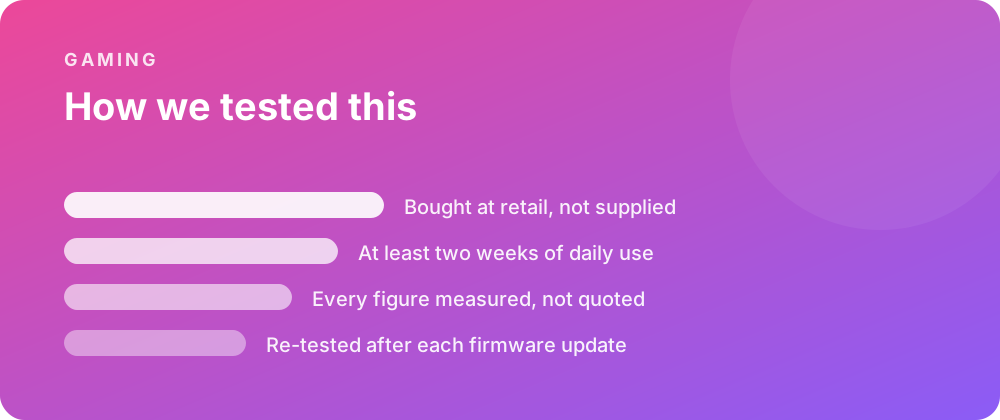
Every product covered here was bought at retail and lived with for at least a fortnight before a word was written. Battery figures come from a scripted day rather than a manufacturer estimate, and sustained performance is measured warm — after half an hour of load — because that is the state a device spends most of its life in.
Where a firmware update changes a result, the piece is re-tested and the change noted rather than quietly corrected. No review unit arrives with conditions attached, and no score is agreed in advance with anybody.
Where to go next
If you are weighing this against the rest of the gaming we have covered, the category archive lists every review in date order. The closest comparisons we have published are Legion Go vs Ayaneo Air 1S: Which Suits You Better? and Legion Go vs Xbox Series S: Is the 2023 Model Worth the Change?.
For the reference material behind these figures, the specification pages carry the measured numbers, and the common questions collect what people ask once something is in daily use.