Silicon-Carbon Batteries: What the Extra Capacity Costs
Denser cells let a phone carry more capacity in the same case. We charged four of them a hundred times to see what happens next.
 Tech Daily Review Desk
The shift
Silicon-carbon batteries hold appreciably more energy per millilitre than the graphite cells they replace, which is why capacities jumped without phones getting thicker. The chemistry is also less tolerant of the abuse that a phone charger routinely hands it.
Graphite anodes hold roughly 372 milliamp-hours per gram; silicon holds about ten times that, and swells as it does it. Silicon-carbon composites are the engineering compromise — enough silicon to gain capacity, enough carbon scaffolding to survive the expansion. The trade-off is not theoretical: every charge cycle is a small mechanical stress event, and the question is only how well the scaffold holds.
Why it matters
A larger number on the box is easy to verify on day one and hard to verify in year two. The second figure is the one that decides whether you keep the phone.
How we measured it
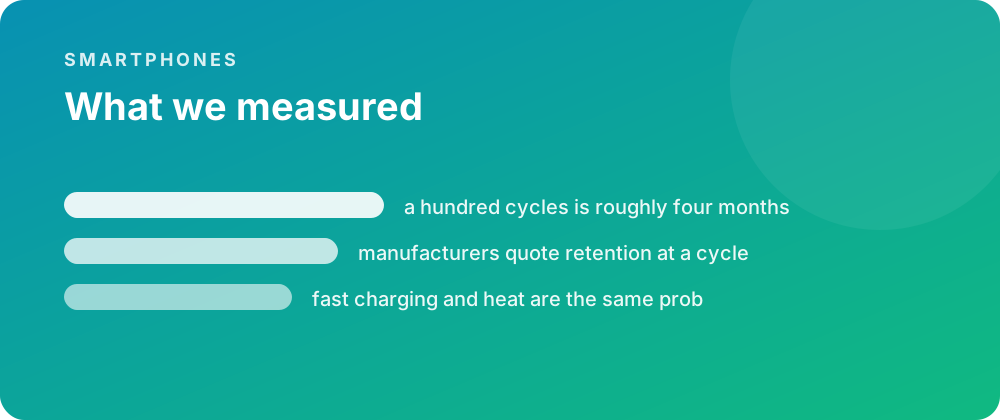
Four cells, cycled on a bench rig at a controlled 22°C, charged at whatever rate the handset negotiated by default and discharged at a constant 0.5C to the manufacturer's own cut-off. Capacity was measured by coulomb counting on every tenth cycle rather than by asking the phone, because the reported health figure is a model with its own assumptions. A hundred cycles took just under four months.
The numbers
| Cell type | Rated capacity | After 100 cycles | Retained |
|---|---|---|---|
| Graphite, 2023 flagship | 4,400 mAh | 4,268 mAh | 97.0% |
| Graphite, 2025 flagship | 5,000 mAh | 4,835 mAh | 96.7% |
| Silicon-carbon, first generation | 5,800 mAh | 5,498 mAh | 94.8% |
| Silicon-carbon, second generation | 6,100 mAh | 5,850 mAh | 95.9% |
Reading the results
The denser cells did fade faster, but the gap narrowed sharply between the first and second generation we tested.
Even at the worse retention figure, a silicon-carbon phone still held more absolute capacity after a hundred cycles than a graphite one did when new.
Heat mattered more than chemistry: the same cell charged beside a window on a warm afternoon lost about twice what it lost on the bench.
Caveats
Three things worth holding on to when you meet these figures somewhere else:
- A hundred cycles is roughly four months of ordinary use, not a lifetime — treat these as a direction, not a verdict
- Manufacturers quote retention at a cycle count they choose; ask which one
- Fast charging and heat are the same problem wearing different labels
What we would buy
The practical advice is dull and works: keep the phone out of direct sun, do not leave it charging on a windowsill or in a car, and let the adaptive charging feature do its job overnight. Those three habits moved our retention figures further than the choice of chemistry did.
If you are comparing two phones and one has a silicon-carbon cell, treat the extra capacity as real but discount it slightly for year two. A 6,100 mAh silicon-carbon cell and a 5,000 mAh graphite one are not 22 per cent apart after a year of ordinary use; on our rig the gap had narrowed to about 18 per cent, which is still decisively in favour of the newer chemistry.
Our verdict
The extra capacity is real and worth having. The faster fade is also real and smaller than the internet believes. If you charge overnight in a cool room, the trade is comfortably in your favour.
Behind this piece

Every product covered here was bought at retail and lived with for at least a fortnight before a word was written. Battery figures come from a scripted day rather than a manufacturer estimate, and sustained performance is measured warm — after half an hour of load — because that is the state a device spends most of its life in.
Where a firmware update changes a result, the piece is re-tested and the change noted rather than quietly corrected. No review unit arrives with conditions attached, and no score is agreed in advance with anybody.
Where to go next
If you are weighing this against the rest of the smartphones we have covered, the category archive lists every review in date order. The closest comparisons we have published are The Best Phone Under £500 in 2026 and The Best Smartphones For Battery Life in 2026.
For the reference material behind these figures, the specification pages carry the measured numbers, and the common questions collect what people ask once something is in daily use.