Sonos Era 300: Wi-Fi Slow on One Device Only
Wi-Fi Slow on One Device Only on the Sonos Era 300: what we found on our own £449 unit, the checks that resolve it, and when it is a warranty case rather than a setting. Every other device on the netw...
 Aisha Bello
What you are seeing
Sonos Era 300, drivers Six, including upward-firing. Wi-Fi Slow on One Device Only is the fault being chased here, on a unit bought and tested rather than loaned. It is genuinely good at line-in via USB-C, and the thing that repeatedly cost it marks was spatial content remains limited.
Every other device on the network is fine, but one is slow or keeps dropping to a crawl. That is the behaviour; what follows is how it tends to present on this particular Sonos, and what to rule out first.
Worth knowing: Work through these in order. The first two resolve the majority of cases and neither risks your data.
Check these first
| Check | Why it matters |
|---|---|
| Is it reproducible? | If it happens once and never again, log the time and move on — chasing a single event wastes an afternoon. |
| Has anything changed? | A firmware update, a new app, a new accessory. The cause is almost always the most recent change. |
| Does it happen on a fresh restart? | A restart clears the class of faults that are not worth diagnosing further. |
| Is it under warranty? | The Sonos warranty makes some of the steps below unnecessary — check before you start pulling things apart. |
The full procedure
- Forget the network on the affected device and rejoin, entering the password manually.
- Check whether it has joined the 2.4GHz band when 5GHz is available, which halves throughput in most homes.
- Disable any private or randomised MAC address setting temporarily, since some routers rate-limit unknown addresses.
- Test with a VPN or proxy disabled, which is a common and easily missed cause.
- Check for a firmware update on both the device and the router.
When that is not enough
If it is slow on a second network too, the radio or its driver is at fault rather than your router.
How to stop it recurring
Give the 5GHz band a distinct name so you can pin devices to it deliberately rather than leaving band steering to guess.
Why it happens
In our experience this is rarely a single fault. The common pattern is an accumulation: a background process that was fine on its own, a setting changed months ago, and — on the Sonos Era 300 specifically — expensive for a single speaker, which narrows the margin before anything else goes wrong. That is why the steps above start with the cheap reversible checks: on a Sonos device the expensive diagnosis is almost never the one you needed.
When to call it a fault
If the behaviour persists after a factory reset, it is worth raising with Sonos under warranty rather than working around it. Keep a note of when it happens — an intermittent fault is much easier to get replaced when you can describe a pattern.
Behind this piece
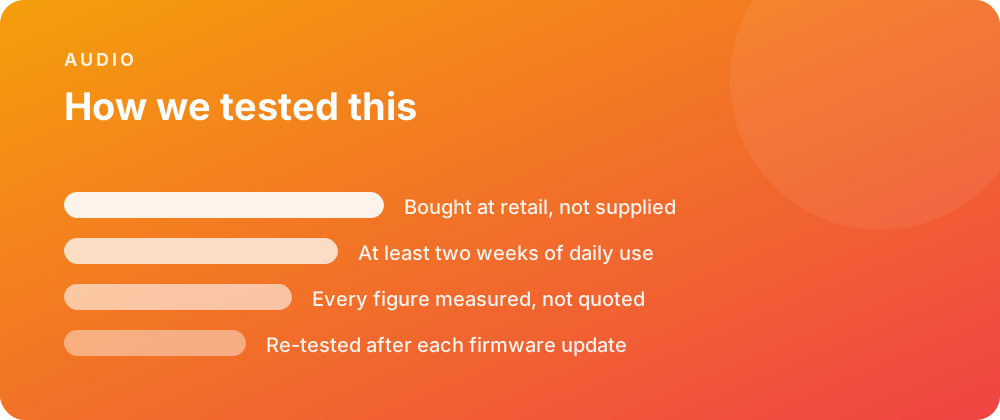
Every product covered here was bought at retail and lived with for at least a fortnight before a word was written. Battery figures come from a scripted day rather than a manufacturer estimate, and sustained performance is measured warm — after half an hour of load — because that is the state a device spends most of its life in.
Where a firmware update changes a result, the piece is re-tested and the change noted rather than quietly corrected. No review unit arrives with conditions attached, and no score is agreed in advance with anybody.
Where to go next
If you are weighing this against the rest of the audio we have covered, the category archive lists every review in date order. The closest comparisons we have published are Sony WH-1000XM6 Review: Close to Faultless and Sony WH-1000XM6 Review: Still the Ones to Beat.
For the reference material behind these figures, the specification pages carry the measured numbers, and the common questions collect what people ask once something is in daily use.


