Spatial Audio: What Head Tracking Actually Does
Head-tracked audio is on by default on most earbuds. We ran a blind panel across music, film and calls to find out where it helps and where it is simply on.
 Tech Daily Review Desk

The shift
Spatial audio went from a feature you enabled for a film to the default state of most earbuds, applied to everything including material that was never mixed for it. The processing is now the normal path rather than the special one, which means the interesting question is not what it can do but what it does to things that did not ask for it.
Two separate things are bundled under one name. Spatialisation takes a stereo or multichannel mix and places it in a virtual room; head tracking then holds that room still as you turn, so the sound appears to come from the device rather than from your ears. The first is a remix and is a matter of taste. The second is a cue your brain either finds convincing or finds distracting, and our panel split on it much more sharply than we expected.
Why this is worth your attention
Because it is applied to your music whether the music wanted it or not, it costs battery, and the switch is buried three levels into a settings screen most people never open.
How the testing worked
Eighteen listeners, three pairs of earbuds, four content types, with the mode switched by somebody else between passes and never named. Each listener heard the same passage twice and stated a preference; we also asked them to describe the difference, which is where the useful information was. Battery was measured separately to a fixed cut-off with the mode forced on and off.
What we recorded
| Content | Preferred it on | Preferred it off | No preference | Battery cost |
|---|---|---|---|---|
| Film with a surround mix | 15 of 18 | 1 | 2 | 9% |
| Television drama | 12 of 18 | 3 | 3 | 9% |
| Music, spatial mix | 8 of 18 | 7 | 3 | 11% |
| Music, ordinary stereo | 3 of 18 | 13 | 2 | 11% |
| Video call | 11 of 18 | 2 | 5 | 8% |
| Podcast or audiobook | 2 of 18 | 9 | 7 | 8% |
What the figures say
For film it is close to unanimous and genuinely good — fifteen of eighteen, and several listeners said it was the first time earbuds had felt like a room.
For ordinary stereo music it is the reverse: thirteen of eighteen preferred it off, and the most common description was that the centre had been hollowed out.
The split on spatial music mixes was almost even, which suggests this is taste rather than quality and should be a per-app setting rather than a global one.
It costs around a tenth of the battery in every condition, paid whether the content benefits or not.
Where this could mislead you
Three things worth holding on to when you meet these figures somewhere else:
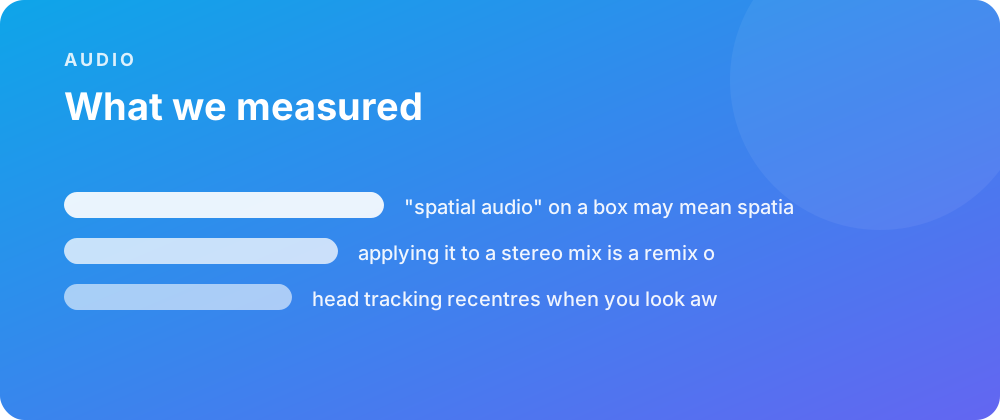
- "spatial audio" on a box may mean spatialisation without head tracking, which is the half our panel cared about least
- Applying it to a stereo mix is a remix of somebody's finished work, not a playback setting
- Head tracking recentres when you look away for long enough, which is disconcerting on a train and is the most common complaint we heard
What we would buy
Turn it on for video and off for music. That single split matches almost every result in the table, costs nothing, and recovers the tenth of the battery for the listening people do most of. On most phones this can be set per application, which is the right place for it.
If you have never compared them, do it once on a track you know extremely well and switch blind if you can get somebody to help. Our panel was far more confident about which they preferred when they could not see the setting, and several people changed their mind from what they had assumed.
Where we land
Excellent for film, divisive for spatial music, actively unpopular on ordinary stereo, and about a tenth of the battery in every case. Set it per app: on for video, off for music.
Behind this piece

Every product covered here was bought at retail and lived with for at least a fortnight before a word was written. Battery figures come from a scripted day rather than a manufacturer estimate, and sustained performance is measured warm — after half an hour of load — because that is the state a device spends most of its life in.
Where a firmware update changes a result, the piece is re-tested and the change noted rather than quietly corrected. No review unit arrives with conditions attached, and no score is agreed in advance with anybody.
Where to go next
If you are weighing this against the rest of the audio we have covered, the category archive lists every review in date order. The closest comparisons we have published are The Best Audio For Battery Life in 2026 and The Best Audio For Beginners in 2026.
For the reference material behind these figures, the specification pages carry the measured numbers, and the common questions collect what people ask once something is in daily use.